After my Matisse procedure in November 2025, I spent months self-wrapping and patiently waiting for my swelling to decrease enough to be measured for new garments.
When my doctor finally ordered my new compression, I was prescribed a 30-40 mmHg sleeve and hand piece.
Up until surgery, I had religiously worn 20-30 mmHg compression.
If you aren’t familiar with compression garments, let me tell you something:
20-30 compression is NO JOKE.
It is heavy. It is tight. It takes effort. It is not like slipping on a cozy sweater.
So when I heard I needed to move up to 30-40 compression for six months, I wasn’t exactly excited. I understood the reasoning, but I also wondered, “How in the world am I going to wear something even tighter every single day?”
When the new sleeve and hand piece arrived, I quickly learned that getting them on was a workout by itself. It took technique, patience, and a surprising amount of strength to pull that puppy on.
I remember thinking, “If I were elderly or had limited strength in my hands, there is no way I could do this by myself.”
But I’m not, and I figured it out.
I have always been incredibly compliant with compression. I wear it. Always. I’m not someone who takes compression breaks. No judgment whatsoever toward people who do — this is just what I have personally done throughout my journey.
So let’s talk about what happened next.
First: Self-Wrapping
I can ace bandage wrap like a PRO.
I have mastered a beautiful chevron pattern. Honestly, it is a skill I never wanted to learn, but now? It’s practically a work of art.
Unfortunately, even with my wrapping skills, I still swell.
My hand swells.
My forearm swells.
Then I moved into my 30-40 compression sleeve and hand piece.
And guess what?
I still swelled.
Experiment #1: Mixing Compression Levels
I decided to experiment.
Important disclaimer: You are generally told that your sleeve and hand piece should match. Your compression should be coordinated and prescribed by someone who understands lymphedema management.
But here’s the thing…
I had followed all the rules.
I was wearing the stronger compression.
I was wrapping.
I was doing what I was told.
And I was still swollen.
So I tried something different.
I wore my 30-40 hand piece with my old 20-30 arm sleeve.
And surprisingly…
Things looked noticeably better.
Not normal. Not perfect. But definitely less swelling.
One thing to note: my old arm sleeve is looser in the upper arm because the Matisse procedure removed some of the tissue volume there. The sleeve is almost loose around my shoulder now.
Experiment #2: Back to My Old 20-30 Set
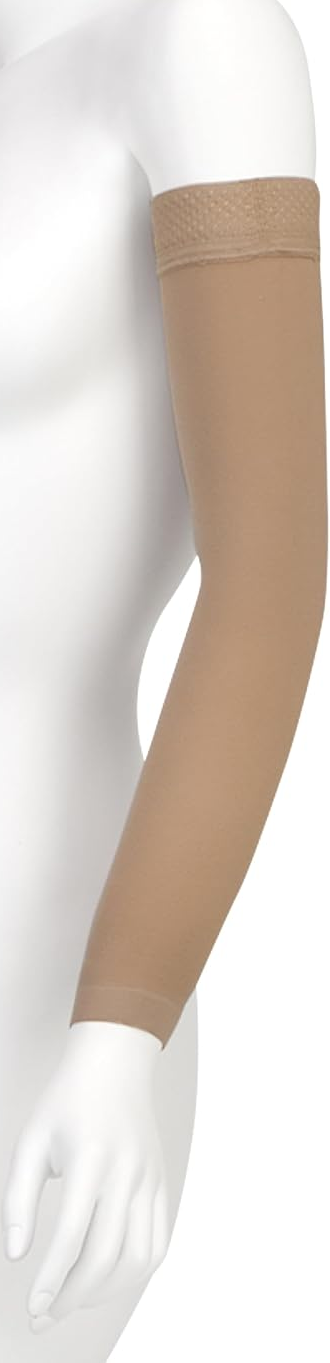
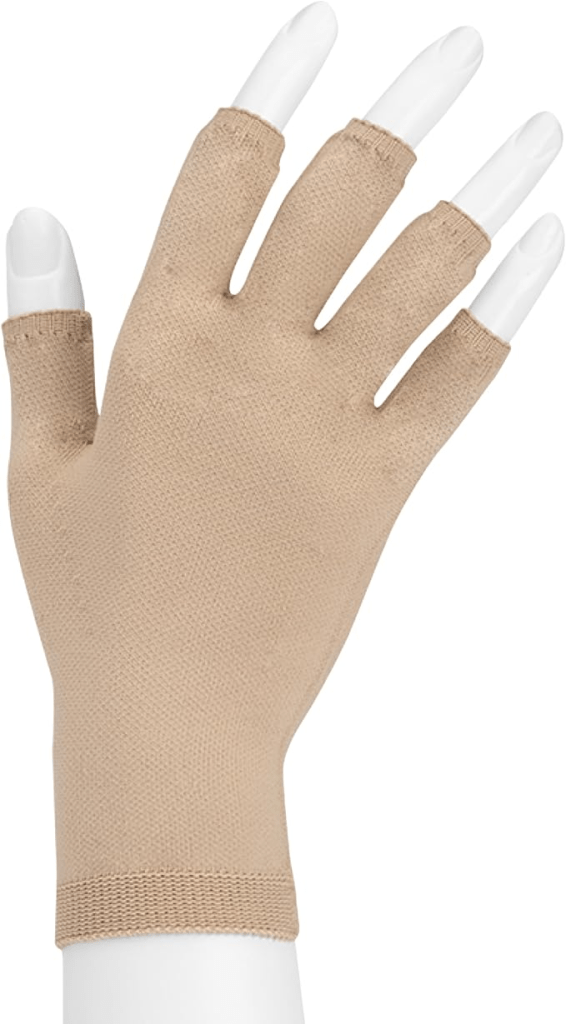
Next, I tried my old 20-30 hand piece and 20-30 sleeve — both from before surgery.
Even better. My hand and forearm seemed happier with less compression. This is the 20-30 set up I use.
Experiment #3: The Unexpected Winner
Finally, I tried something I hadn’t worn much since early in my lymphedema journey:
My lightweight, off-the-shelf Juzo sleeve and hand piece.
This was the compression I originally used before my arm and hand became permanently swollen. I wore it for prevention when hiking, biking, during hot weather, or at higher elevations.
And after wearing it for a few hours…
My arm and hand looked the best they have looked in a long time.
I was shocked.
What I’m Doing Now
Now, I want to be clear:
I am not wearing lightweight compression for everything.
I would not wear it for weight lifting.
I would not wear it outside during the summer heat.
I do NOT wear it to lift weights.
I’m not confident it would control my swelling during those activities.
But around the house?
Working at my desk?
Normal daily activities?
The lighter compression seems to be what my arm wants right now.
Do I know why?
Nope. But here is the theory behind why I tried it:
Look Upstream.
If there is a problem, look upstream.
You know how when your knee hurts, the problem isn’t always your knee? Sometimes it’s tight hip flexors, weakness somewhere else, or an issue with your back that is changing the way your body moves.
I started wondering if the same concept could apply to lymphedema.
I started looking upstream.
If my forearm is swollen, could the compression around my upper arm be too tight and actually making it harder for fluid to move?
If my hand is swollen, could the compression around my wrist be creating a bottleneck and causing fluid to collect in my hand?
What if the problem isn’t always where the swelling shows up?
What if we need to look at what is happening before the swelling?
This was the theory I applied during my compression experiments.
Now, I want to be very clear — this is just my personal observation and my own experiment. I am not a lymphedema therapist, and I’m not saying this is true for everyone.
But after years of learning about my own body, paying attention, and trying to understand this unpredictable disease, I do think there may be something to the idea of looking upstream.
Because anyone who lives with lymphedema knows:
Sometimes the answer isn’t where the problem appears. Sometimes you have to follow the flow.
I talked through all of this with my CLT (who is AMAZING), and she encouraged me to pay attention to what my body was telling me. She isn’t against experimenting — because anyone who has lived with lymphedema knows:
Sometimes this disease does things that don’t make sense.
Compression isn’t always simple. More isn’t always better. The “perfect” garment on paper isn’t always the one your body responds to best.
I’m still at the beginning of changing things up, and I’ll keep sharing what I learn.
I would love to know…
Has anyone else experimented with different levels of compression and discovered that your body actually preferred something different than what you expected?
 Lymph Living
Leave a comment